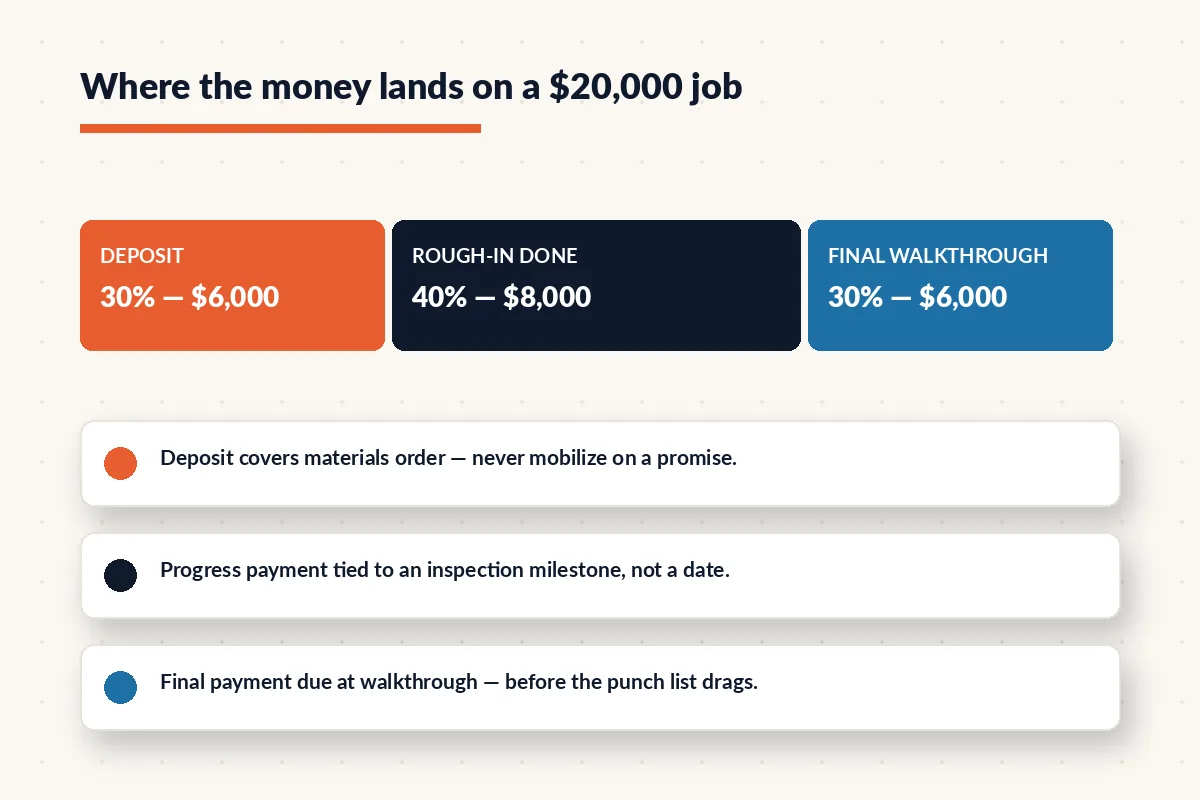
Quick answer: For most residential trade work, ask for 10–30% down — enough to cover the materials order plus your first days of labor, and never so much that you’re holding money you haven’t earned. A common healthy structure on a mid-size job is 30% at signing, 40% at a mid-job milestone, 30% at final walkthrough. Some states cap deposits on home-improvement work (California: 10% or $1,000, whichever is less), so check your state before you write your contract. The deposit’s real job isn’t cash — it’s commitment: a client with money in the job doesn’t ghost, doesn’t stall the start date, and doesn’t shop your bid around town.
What is a normal deposit by job size?
There’s no single right number, but here’s the range experienced contractors actually use:
- Small jobs (under ~$2,000): 50% down or even payment in full for materials-heavy quick work. The paperwork cost of chasing a $600 balance isn’t worth it.
- Mid-size jobs ($2,000–$25,000): 25–35% down, with the rest split across one or two milestones and a final payment.
- Large jobs ($25,000+): 10–20% down with a milestone schedule doing the heavy lifting. On a $60,000 job, a 33% deposit starts to look alarming to clients — and to state regulators.
- Custom-ordered materials: whatever the range, collect enough to fully cover any non-returnable special orders (custom windows, cabinetry, specialty tile) before you place the order. If the client walks, you should not own their cabinets.
Does your state cap contractor deposits?
A few states regulate this directly for home-improvement contracts, and the penalties are real:
- California: the down payment on a home-improvement contract may not exceed $1,000 or 10% of the contract price, whichever is less. Asking for a third up front on a remodel is a license-discipline issue there.
- Massachusetts: home-improvement deposits are generally capped at one-third of the contract price, plus the cost of special-order materials.
- Maryland: home-improvement contractors generally may not collect more than one-third of the contract price as a deposit.
Most states have no hard cap, but consumer-protection offices everywhere treat “big deposit, slow start” as a fraud pattern. Wherever you work, the combination that keeps you safe is the same: a reasonable deposit, a written schedule, and visible progress. This is not legal advice — check your own state’s contractor board before setting your standard terms.
How should you structure the full payment schedule?
The deposit is just the first row. The schedule is what protects your cash flow for the whole job. Three rules:
- Tie payments to milestones, not dates. “40% when rough-in passes inspection” can’t be argued with. “40% on June 20” invites “but you weren’t done on the 20th.”
- Keep every stage earned-ahead-of-paid as close as you can. You want the client’s money slightly behind your completed work at all times — never so far ahead that they’re funding next month, never so far behind that you’re the bank.
- Make the final payment small enough to not be worth fighting over, but real enough to matter — 10–30% depending on job size. A 50% final payment is a hostage situation waiting for a punch-list dispute.
Put the schedule in the contract itself as a simple table — our free contractor contract template has the payment-schedule section pre-built. Then invoice each milestone the day it’s hit (here’s the invoice layout that gets those paid in days, not weeks).
How do you word the deposit request?
Confidently and with a reason attached. The script that works:
“To get you on the schedule it’s 30% down — that covers your materials order and locks your start date. Then 40% when rough-in passes inspection, and the last 30% at final walkthrough when you’ve signed off.”
Every number has a job attached to it, which is exactly what makes it feel fair. Take the deposit by check, card, or bank transfer tied to your business — and put it in the contract, not a text message. A deposit without a signed contract behind it is just a refund dispute you haven’t had yet. (Not sure whether you’re sending an estimate, a quote, or something binding? Here’s the difference — the deposit belongs with the signed quote or contract, never the estimate.)
What if the client pushes back on the deposit?
Some pushback is reasonable — a homeowner who’s been burned before may flinch at anything over 10%. Meet that with structure, not surrender: offer a smaller deposit with tighter milestones (“10% down, but the rough-in payment moves up to 50%”), or offer to hold the special-order receipt against their deposit so they can see where it went. What you don’t negotiate away is having a deposit and a schedule at all. A client who wants zero down, payment “when it’s all done,” on a five-figure job isn’t a client — they’re an unsecured loan with a kitchen.
And the red flag runs both ways: a contractor demanding 60% up front on a big job is the stereotype every homeowner has been warned about. If your cash flow requires huge deposits to survive, the problem is usually pricing (margin too thin) or scheduling (too many jobs open at once), not the deposit percentage.
Put your payment schedule in writing tonight
Free downloads, no signup: the contractor contract template with a milestone payment schedule built in, and the contractor invoice template for billing each milestone the day it’s hit. The complete QA’d pack lives in the template shop →
Contractor deposit FAQ
Is a contractor deposit refundable if the client cancels?
Whatever your contract says — which is why the contract must say it. A fair standard: refundable minus documented costs already incurred (special orders, permit fees, time on design), with a short no-questions cancellation window if your state requires one (many home-improvement laws include a three-day right of rescission).
Should I charge a deposit for small repair jobs?
Under a few hundred dollars, usually no — payment in full on completion, same day, is the norm and the paperwork isn’t worth it. The exception is any job with ordered parts: collect the parts cost up front, every time.
Can I use the deposit from one job to finish another?
Legally that’s exactly the pattern that gets contractors charged with conversion or fraud in several states when the music stops. Treat each deposit as that job’s materials-and-mobilization money. If you need float, that’s what a line of credit is for — it’s cheaper than a felony.
Deposit vs. retainer — what’s the difference?
A deposit is pre-payment against a specific contracted scope. A retainer buys availability — common for service contractors holding response-time slots for commercial clients. Don’t call your deposit a retainer in the contract; the legal treatment differs and sloppy language helps nobody.
Leave a Reply