Free Contractor Contract & Service Agreement Template
A contractor contract needs eleven things to actually protect you: the parties and your license number, a written scope of work, the total price and a payment schedule, a change-order clause, a workmanship warranty, your lien or notice rights, a dispute-resolution and venue clause, a termination clause, proof-of-insurance language, who pulls permits, and — for jobs sold at the client’s home — a cancellation and right-to-rescind notice. Requirements vary by state, and this page is general information, not legal advice. Below is a free layout for Word or PDF, plus a plain-English walk-through of every clause and why it exists.
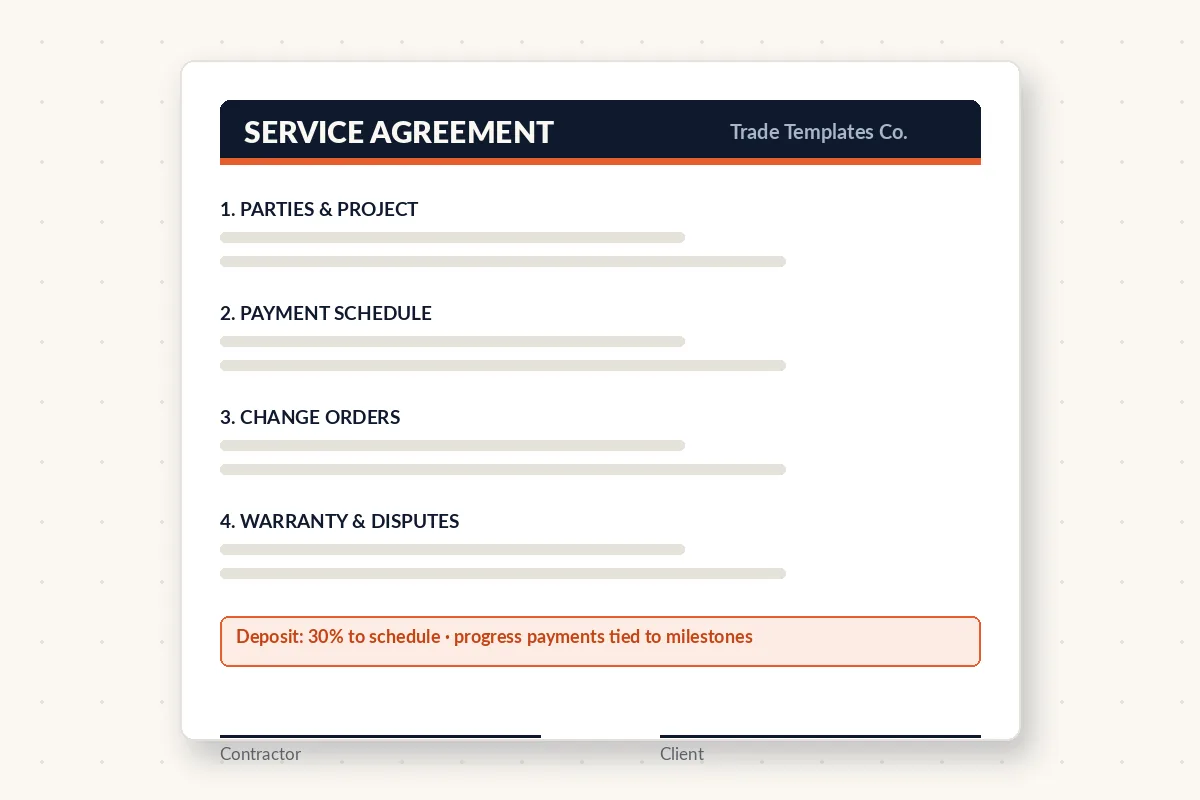
An invoice tells the client what they owe. A proposal tells them what they’ll get. A contract is the only one of the three that holds up when something goes wrong — a payment dispute, a client who changes their mind mid-job, a subcontractor injury, or a lien filed against a property you worked on. Most solo contractors run on a signed proposal alone, which covers price and scope but leaves the clauses that matter in a dispute completely unwritten. Here is what belongs in the document that actually protects you.
What every contractor contract needs
These eleven clauses are the ones attorneys and trade associations point to first when a job goes sideways:
- Parties and license number — your legal business name, license number, and the client’s full legal name, matched exactly to the property title.
- Scope of work — specific enough that “everything not listed here is excluded” actually means something.
- Price and payment schedule — total price, deposit amount, draw milestones, and final payment trigger.
- Change-order clause — states that any work outside the written scope requires a signed, priced change order before it starts.
- Warranty — what is covered, for how long, and what voids it (client-supplied materials, other trades working on top of your work).
- Right to lien / preliminary notice — a statement that non-payment may result in a mechanic’s lien, plus any notice you are required to send before you can file one.
- Dispute resolution and venue — mediation or arbitration before litigation, and which county or state’s law governs the contract.
- Termination clause — how either party can end the job early, and what is owed for work completed to that point.
- Insurance — a statement that you carry general liability (and workers’ comp where required), with a certificate available on request.
- Permits — who pulls and pays for them, and confirmation the price includes or excludes permit fees.
- Cancellation / right to rescind — on contracts signed at the client’s home, federal and many state rules give the client a 3-business-day window to cancel without penalty; this notice has to be in the contract, not assumed.
The contract, clause by clause
Here is what each clause actually does for you when a job stops going smoothly — the plain-English version of language that otherwise reads like boilerplate:
| Clause | What it says | Why it protects you |
|---|---|---|
| Scope of work | Exactly what is and is not included | Ends the “I thought that was included” argument |
| Payment schedule | Deposit, draws, final payment triggers | Keeps you from financing the job out of pocket |
| Change orders | Extra work requires a signed, priced addendum | Stops scope creep from going unpaid |
| Warranty | Coverage period and what voids it | Limits your exposure after the job ends |
| Lien / notice rights | States your right to file a lien on non-payment | Preserves your strongest non-payment remedy |
| Dispute / venue | Mediation first; governing state and county | Keeps a dispute local and out of court longer |
| Termination | How either side exits and what is owed | Prevents a walk-off from becoming a total loss |
| Insurance | Confirms coverage is active | Reassures the client and limits your liability |
| Permits | Who pulls them and who pays | No confusion over an unbudgeted permit fee |
| Right to rescind | 3-day cancellation window on in-home sales | Required in many states — omitting it can void the contract |
The clause most contractors skip: right to rescind
If you sold the job at the client’s home rather than at your place of business, federal law (the FTC’s Cooling-Off Rule) and many state consumer-protection statutes give the client three business days to cancel without penalty — and require you to say so, in writing, on the contract itself. Leave this notice off and some states allow the client to cancel well past the 3-day window, or void the contract’s enforceability entirely. It costs one paragraph to include and it is one of the most commonly missed clauses on contractor-written agreements.
The clause that saves the most money: change orders
“While you’re here, can you also…” is how unpaid scope creep starts. A change-order clause requiring a signed, priced addendum before any extra work begins turns that sentence from a favor into a billable event — and it is the single clause most likely to put money back in your pocket on a normal job.
Remodeling & Home Improvement Contract (Word, Google Docs & PDF)
The clauses above, pre-written in plain English — scope, allowances, progress payments, change orders, warranty, a punch-list rule and the Notice of Cancellation, with a filled example. Different trade? The shop has contracts for ten trades.
Requirements vary by state — what to check before you send it
Contract law for home improvement work is set state by state, and a handful of items are worth confirming for wherever you work: some states cap the deposit you can collect up front (commonly 10% of the contract price or a fixed dollar amount, whichever is less); many states require specific bold or all-caps language for the right-to-rescind notice, not just the concept; several states require your license number to appear in a specific size or location on the contract; and preliminary notice deadlines for lien rights can run as short as 20 days from first furnishing labor or material. None of that is universal, which is exactly why a generic contract template is a starting point, not a finished legal instrument.
This page and the template above are general information, not legal advice. Have a contract reviewed by an attorney licensed in your state before you rely on it for a real job — particularly the deposit cap, right-to-rescind, and lien-notice language, which change most often. For the documents that sit next to your contract on a real job, see our subcontractor agreement template, lien waiver template, and change order form.
Frequently asked questions
Is this contract template legally binding in my state?
It is a strong starting point covering the clauses attorneys look for first, but contract law varies by state. Have it reviewed by an attorney licensed where you work before relying on it, especially for deposit caps and cancellation-notice wording.
What is the difference between a proposal and a contract?
A proposal presents scope and price to win the job. A contract adds the protective clauses — payment schedule, warranty, lien rights, dispute resolution, termination, insurance, and cancellation rights — that matter once the job is underway.
Do I need a right-to-rescind clause on every contract?
It is required on many contracts signed at the client’s home rather than your place of business, under federal and state consumer-protection rules. Confirm your state’s specific wording requirement rather than assuming a generic sentence is enough.
How much deposit can I legally collect up front?
It depends on your state. Some cap deposits at a percentage of the contract price or a flat dollar amount, whichever is lower. Confirm your state’s cap before setting your standard deposit percentage.
Does a change-order clause need a client signature every time?
Yes, ideally. A change order without a signature is hard to enforce if the client later disputes the extra charge, so build the signature line into your change-order form itself, not just the master contract.
Get the Tuesday Template
One field-tested back-office template and a get-paid-faster tip in your inbox each week. No fluff.