Free Contractor Invoice Template (PDF, Word & Google Sheets)
A contractor invoice needs nine things to get paid fast: your business + license info, the client’s info, a unique invoice number, the issue and due dates, an itemized scope (labor and materials separated), the subtotal, any sales tax, the total due, and clear payment terms. Below is a free layout you can rebuild in Google Sheets, Word, or PDF — plus the exact line items that get a $5,200 job paid in 7 days instead of 60.
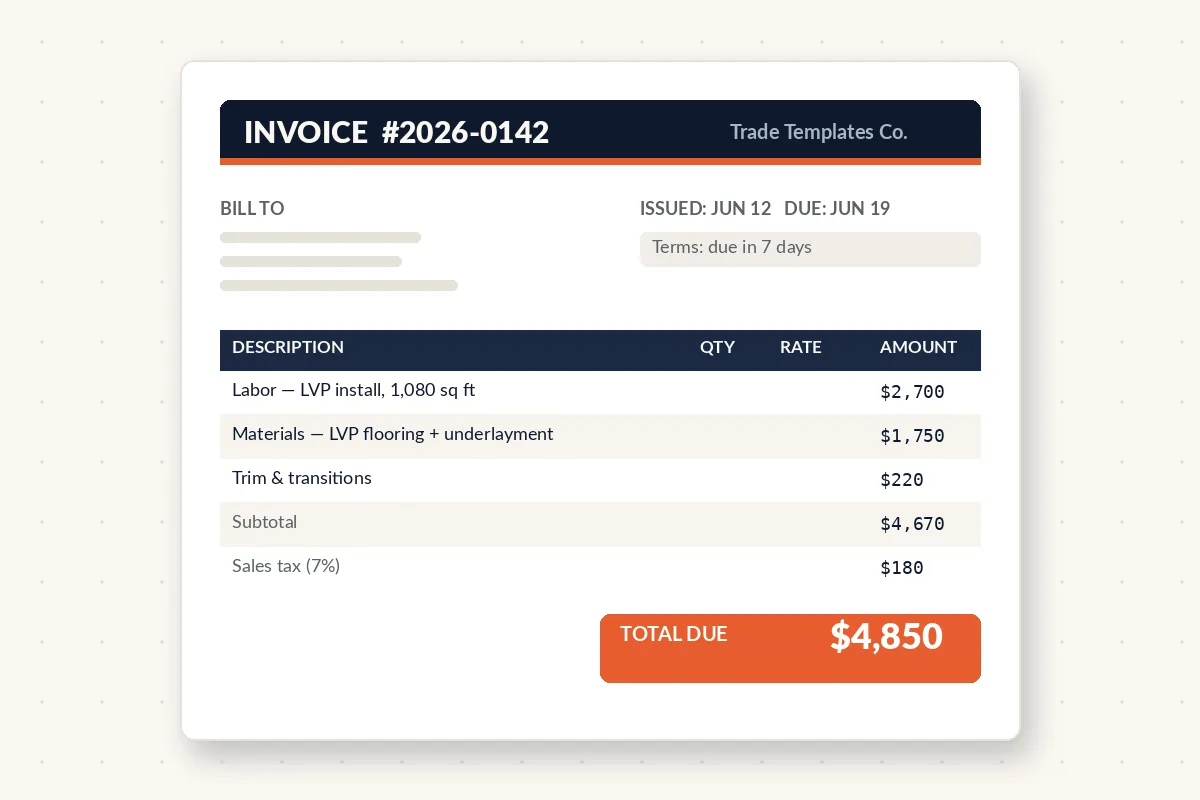
Most contractors lose money on invoices two ways: they send them late, and they send them vague. A vague invoice (“Flooring work — $5,200”) gives a slow-paying client every excuse to question the number. An itemized invoice with clear terms gets paid because there’s nothing to argue about. Here’s exactly what to put on it.
The 9 line items every contractor invoice needs
Leave any of these off and you give the client a reason to delay:
- Your business name, address, phone, and license number. In states like Florida, California, and Arizona, your license number on the invoice isn’t optional — it’s expected, and on permitted work it protects your lien rights.
- The client’s name and the job address (which is often different from their billing address).
- A unique invoice number — e.g., 2026-0142. Sequential numbers make your bookkeeping and taxes far cleaner at year end.
- Issue date and due date. “Due on receipt” or a real calendar date — never just “Net 30” with no date.
- Itemized scope, with labor and materials on separate lines. This is the single biggest thing that gets invoices paid without a fight.
- Subtotal.
- Sales tax, where your state taxes the labor or materials (this varies a lot by state — more below).
- Total due, in bold, at the bottom.
- Payment terms and methods — how they pay, by when, and the late fee if they don’t.
A real invoice, line by line (a $5,200 LVP job)
Here’s how a 1,000-square-foot luxury-vinyl-plank install actually breaks down on the invoice — the level of detail that ends payment disputes before they start:
| Line item | Detail | Amount |
|---|---|---|
| LVP material | 1,050 sq ft (incl. 5% waste) @ $2.00 | $2,100 |
| Underlayment + transitions | materials | $500 |
| Installation labor | 1,000 sq ft @ $2.50 | $2,500 |
| Floor prep + haul-away | labor | $100 |
| Subtotal | $5,200 |
On a material-heavy job like this, you’d typically invoice a deposit of 30–50% at signing ($1,560–$2,600 here) and the balance due on completion — not 30 days later. Splitting labor from materials also means if the client disputes anything, it’s a single $500 line, not the whole $5,200.
Net terms: why “due on receipt” beats “Net 30”
Payment terms set how fast you get paid. A “Net 30” invoice realistically lands in your account in 30–45 days. The same invoice marked due on receipt with a card or ACH link attached often clears in 2–5 days. For anything over ~$8,000, switch to progress billing — bill at milestones (deposit, rough-in, completion) so you’re never floating the whole job.
Contractor Invoice + Late Payment Reminders
Add the late-payment reminder sequence and deposit billing system — get paid in 7-10 days.
Payment methods and the fees that eat your margin
Cards (Stripe, Square, PayPal) cost about 2.9% + $0.30 per transaction — on a $5,200 invoice that’s roughly $151 gone. ACH/bank transfer usually runs ~0.8% capped around $5, so it’s the cheapest way to take a big balance. Two clean options: offer a 2% discount for cash/check/ACH, or add a card surcharge where your state allows it. Either way, decide before you send the invoice, not after.
Late fees and follow-up that actually works
A late fee only sticks if it’s written on the invoice and in your contract — commonly 1–1.5% per month on the unpaid balance (check your state’s cap). Then work a simple cadence: a friendly reminder the day it’s due, a firmer note at +7 days that applies the late fee, and at +15 days a notice referencing your lien rights. Most invoices get paid at the +7 nudge — but only if the terms were on the invoice to begin with. (This is general information, not legal advice — your state’s rules govern.)
Frequently asked questions
Can I edit the invoice in Google Docs or Word?
Yes. The template comes in Word, Excel, and Google Sheets — open it, drop in your logo and license number, and the totals calculate themselves. No special software needed.
Do I charge sales tax on labor?
It depends entirely on your state. Some tax labor on real property, some only tax materials, some tax neither. Put a sales-tax line on the invoice and set the rate for your state — and check your state’s rule before you file.
What deposit should I ask for?
For material-heavy trades like flooring, 30–50% at signing is standard — enough to cover your material order so you’re not financing the client’s job out of pocket.
“Due on receipt” or “Net 30”?
Due on receipt, with a payment link, for residential jobs — it gets you paid in days. Save Net 15/30 for commercial clients who require it, and use progress billing on large jobs.
What do I do if a client won’t pay?
Send the reminder cadence above. If it’s still unpaid, a formal demand letter and your lien rights are the next steps — which is why the license number and clear scope on the invoice matter so much.
Get the Tuesday Template
One field-tested back-office template and a get-paid-faster tip in your inbox each week. No fluff.