Construction Estimate Template (Excel, Google Sheets & PDF)
A construction estimate template should total five cost buckets — materials, labor (at your burdened rate), subcontractors, equipment/permits, and a contingency — then apply markup to hit your target margin. The trap that bankrupts contractors: confusing markup with margin. A 20% markup is only a 16.7% margin. Below is the structure, the real math on a $12,700 job, and a template that does it for you.
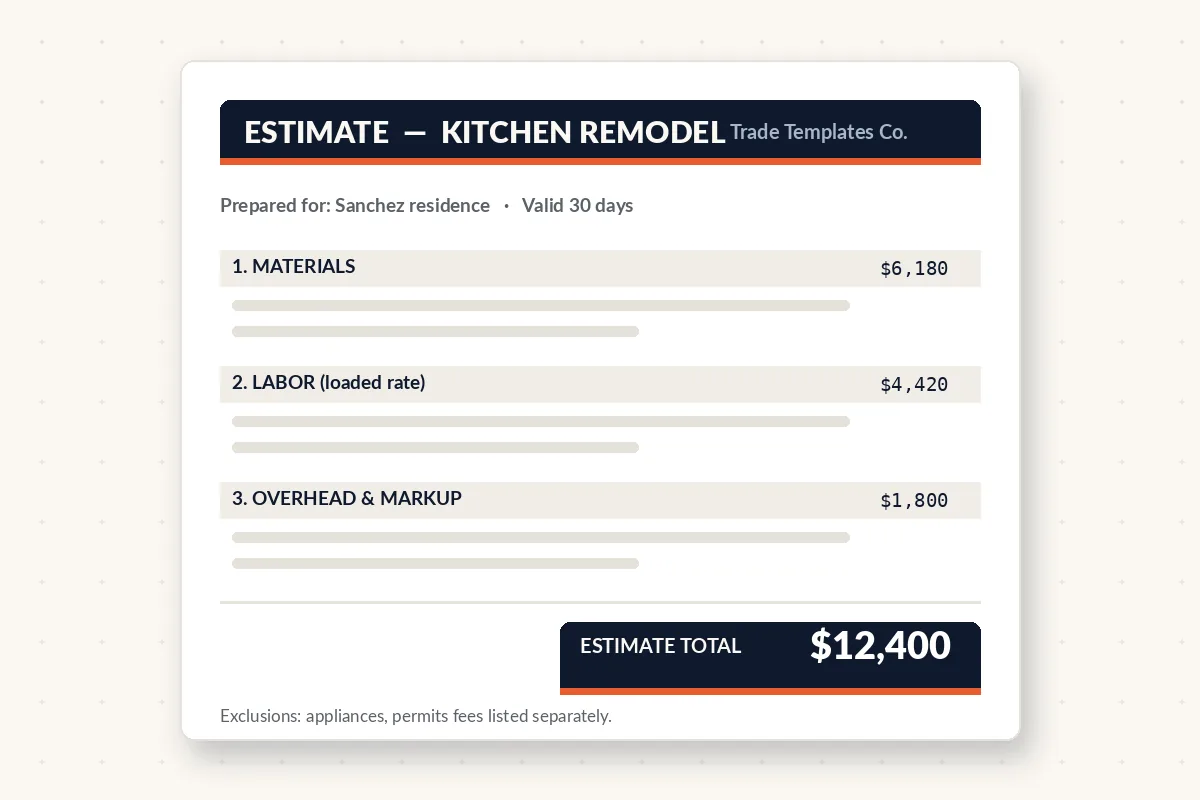
An estimate is where you make or lose the job’s profit — before a single tool comes off the truck. Underbid and you work for free; overbuild the number and you lose the job. A good construction estimate template forces you to count every cost and apply the right markup so the price protects your margin automatically.
The five cost buckets every estimate needs
- Materials — with a waste factor built in (5–10% for most trades; 10%+ for tile and patterned flooring).
- Labor — at your burdened rate, not the wage. A $25/hr installer really costs you ~$33–38/hr after payroll taxes, workers’ comp, and overhead. Estimating at the raw wage is how contractors quietly go broke.
- Subcontractors — plumbing, electrical, anything you don’t self-perform.
- Equipment, permits, and dump fees — the line everyone forgets.
- Contingency — 5–10% for the unknowns on a remodel (rot, code surprises, substrate).
Get your true labor cost right first — run the numbers in our free Labor Burden Rate Calculator before you estimate anything.
A real estimate, line by line (a $12,700 bathroom remodel)
| Cost bucket | Detail | Cost |
|---|---|---|
| Materials | tile, fixtures, vanity, board (incl. 8% waste) | $4,800 |
| Labor | 100 hrs @ $55 burdened | $5,500 |
| Subcontractors | plumbing + electrical | $2,000 |
| Permits + dumpster | $400 | |
| Direct cost | $12,700 |
Now the part that decides whether you actually make money.
Markup vs margin — the mistake that quietly kills contractors
Say you want a 25% profit margin on that $12,700 job. If you “add 25%,” you charge $15,875 — but your margin is only 20%, because the profit ($3,175) is measured against the bigger final price, not the cost. To actually keep a 25% margin, you divide by (1 − 0.25): $12,700 ÷ 0.75 = $16,933. That $1,058 gap is real money you’d have left on the table on a single job — multiply it across a year.
The rule: margin = (price − cost) ÷ price. Don’t eyeball it. Run it in the free Markup vs Margin Calculator, or let the template below apply the correct markup for your target margin automatically.
Contractor Estimate Calculator (General Construction)
Auto-calculating estimate spreadsheet: enter materials, hours, your burdened labor rate, subs, and a target margin — it returns the price that actually hits that margin, line by line. Built for any trade. Editable in Excel and Google Sheets.
What separates a winning estimate from a losing one
Itemize enough that the client sees value, but not so much that every line becomes a negotiation. Show allowances for client-selected finishes (tile, fixtures) so upgrades don’t eat your margin. Put a clear scope and an expiration date on the estimate — material prices move, and a 60-day-old number can be a money-loser. And when the job is approved, the estimate should flow straight onto your invoice so nothing gets dropped between bid and bill.
Frequently asked questions
Is the construction estimate template editable in Excel and Google Sheets?
Yes — it opens in both, with the formulas already built. Enter your numbers and the totals, markup, and final price calculate themselves.
What markup should a contractor use?
It depends on your target margin and overhead, but most small contractors need a 30–50% markup on direct cost to net a healthy margin after overhead. The key is to back into markup from your target margin, not guess.
How much contingency should I add?
5–10% on remodels where hidden conditions are likely (rot, old wiring, uneven substrate). New construction can run lower; gut renovations higher.
How long should an estimate stay valid?
Put an expiration date on it — commonly 30 days — because material prices move. An old estimate honored at today’s costs can wipe out your margin.
Get the Tuesday Template
One field-tested back-office template and a pricing tip in your inbox each week. No fluff.