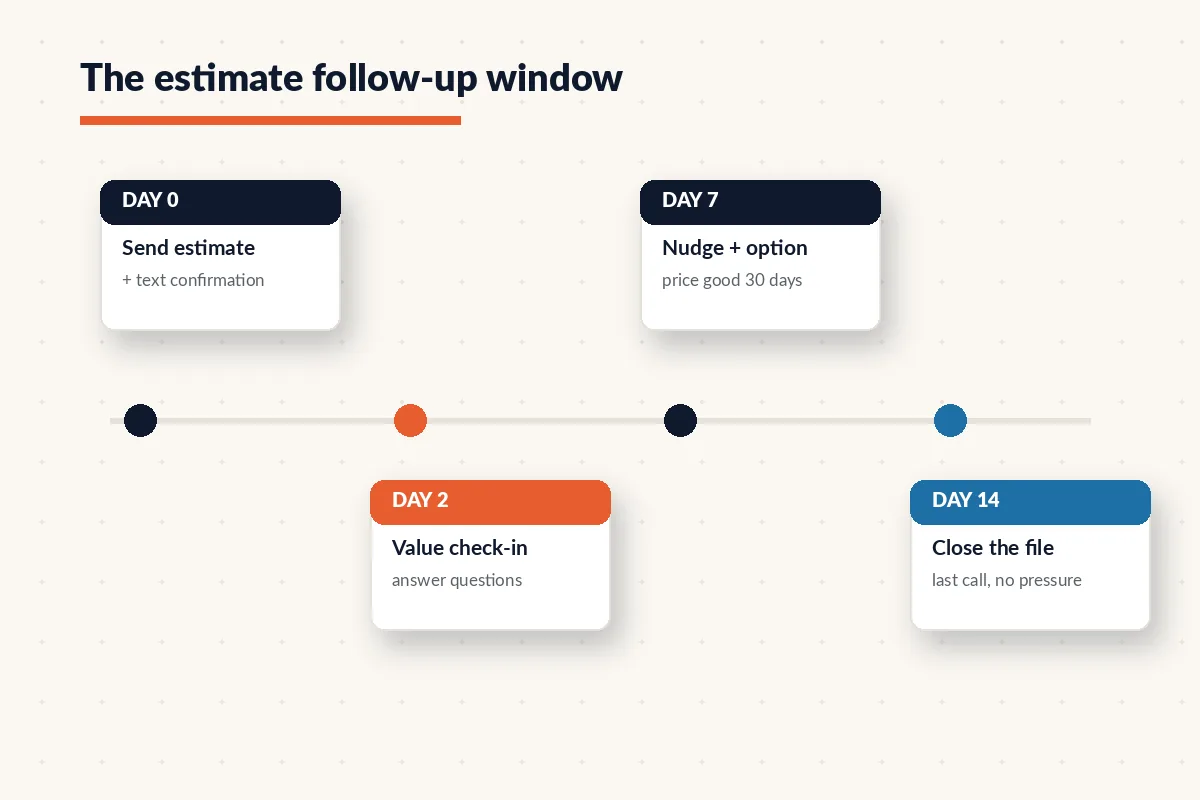
Quick answer: Follow up on every estimate three times: a value check-in on day 2 (“wanted to make sure it came through — happy to walk you through it”), a nudge with something new on day 7 (an option, a start-date window, a reminder the price holds 30 days), and a polite close-the-file message on day 14. Text is the highest-response channel for residential clients; email leaves the paper trail for commercial. Never open with “just checking in,” never discount out of silence, and stop after three touches — the sequence wins the jobs that were winnable and protects your time from the rest.
Why do good estimates die in silence?
Usually not because the price was wrong. Homeowners sit on estimates because they’re comparing bids, waiting on a spouse, or just busy — and every day of silence makes it more awkward for them to reply. Meanwhile most contractors never follow up at all: the estimate goes out, two weeks pass, the job quietly goes to whichever bidder happened to call back. Following up isn’t pestering — it’s finishing the sales work you already paid for when you drove out, measured, and priced the job. You’ve sunk an hour or two into every estimate; three short messages is how that investment gets a verdict instead of a shrug.
When should you follow up on an estimate?
The cadence that balances persistence and dignity:
- Day 0 — send it properly. The estimate goes out the same day you promised, with a one-line text: “Just sent your estimate to your email — let me know if it doesn’t show up.” That text does double duty: it confirms delivery and quietly opens a text thread, which is where the rest of the sequence lives.
- Day 2 — the value check-in. Questions surface in the first 48 hours. Get to them before the other bidder does.
- Day 7 — the nudge with something new. A week is long enough to have compared bids; your message should add information, not pressure.
- Day 14 — close the file. A no-pressure final message that either revives the job or releases it.
What do you say on day 2?
Text: “Hi Sarah — Mike from Ridgeline. Wanted to make sure the estimate came through okay. If any line item needs explaining, happy to walk you through it — some of it (like the subfloor work) has a story behind it.”
Why it works: it assumes nothing, offers help, and hints that the number has reasoning behind it — which invites the price conversation while you’re present for it, instead of letting sticker shock harden in private. If they reply with a question, answer it fully and end with a soft step: “Want me to pencil you in for the week of the 8th while you decide? No commitment — it just holds the slot.”
What do you say on day 7?
Add something new. Repeating “any thoughts?” makes silence heavier; new information gives them a reason to re-open the file:
Option A — scope option: “Been thinking about your project — if the full scope is more than you want to take on this season, I can split out the exterior work as phase one and price it standalone. Want me to send that version?”
Option B — schedule reality: “Heads up — my June schedule is filling and I’d hate for your job to slip to midsummer. The estimate’s good for 30 days either way. If you’re leaning yes, a signed go-ahead this week locks the June window.”
Both are honest, both give the client a genuinely easier next step, and neither touches the price. If your estimates routinely need a good-better-best structure to give clients options up front, build it into the document itself — the free proposal template has the three-option layout pre-built, and it noticeably reduces day-7 stalls because the client already has a cheaper “yes” available.
What do you say on day 14?
The close-the-file message — the most underused tool in contractor sales:
“Hi Sarah — closing out my estimate list for the month. If you’ve gone another direction, no hard feelings at all, and I appreciate you considering us. If the project’s just on pause, say the word and I’ll keep the file open. Either way, thanks!”
This message wins jobs precisely because it doesn’t chase. It gives a graceful exit to people who chose someone else (you’ll get a reply, which beats wondering), and it routinely shakes loose the “sorry!! yes we want to proceed, life got crazy” replies that were never actually lost. After day 14, stop. Add them to a spring re-contact list if the trade is seasonal, and move on.
What should you never do while following up?
- Don’t discount into silence. An unprompted “I could knock 10% off” reads as “my first number was padded.” If price is the stated objection, trade scope for money — never just money.
- Don’t guilt. “I took time to come out and measure…” ends the relationship even if it wins the job.
- Don’t send the fourth follow-up. Three structured touches read as professional. Five read as struggling.
- Don’t follow up on an estimate you’re not proud of. If the document itself is a vague two-line total, the best script can’t save it — an itemized, professional-looking estimate is what makes the follow-up feel like service instead of pressure. Start from the free construction estimate template if yours needs the upgrade.
Which channel — call, text, or email?
For residential: text first — response rates crush email and it’s the least intrusive interruption. Email backs up anything with attachments or revised numbers. A phone call is right for day-7 conversations on jobs over ~$15,000, where a voice builds the trust a text can’t — but leave at most one voicemail, and follow it with a text (“just tried you, no rush — text works fine”). For commercial and property-management work, flip it: email is the channel of record, and the follow-up sequence rides on a clean paper trail.
Send estimates worth following up on
Free, no signup: the itemized construction estimate template and the good-better-best contractor proposal template. The full QA’d pack — estimates, contracts, invoices, job costing — is in the template shop →
Estimate follow-up FAQ
How long should an estimate stay valid?
Thirty days is the working standard — long enough to decide, short enough that material-price moves don’t eat you. Print the expiration on the estimate itself; it makes the day-7 “price holds till the 28th” message a fact, not a tactic.
Should I follow up after losing the job to another bid?
Yes, once, graciously: “Thanks for letting me know — if anything changes or you need a second opinion down the road, my number doesn’t change.” A meaningful share of “lost” jobs come back within a year when the cheap bid underdelivers, and you want to be the easy call.
What if they ask me to match a lower bid?
Ask to see the scope, not the number. Most lowball bids omit something — disposal, permits, prep, warranty. Walk the client through the difference line by line and offer to adjust scope to meet budget. If someone’s genuinely doing your identical scope for 30% less, let them have it — that job loses money.
Does automating follow-ups make sense for a small shop?
The schedule, yes — a reminder system or even calendar alerts so day-2 and day-7 never slip. The messages, mostly no: at small-shop volume, the personal detail (“the subfloor line has a story”) is exactly what canned sequences can’t fake, and it’s why yours get answered.
Leave a Reply