Quick answer: Price a change order the same way you priced the original job — materials plus loaded labor plus your standard markup — then add a flat administrative fee ($50–$250 depending on job size) for the disruption, re-sequencing, and paperwork. Put it in writing before the work happens, get a signature (digital is fine), and never let “while you’re here” work start on a handshake. Contractors who price change orders this way protect their margin; contractors who wing it donate free work on almost every job.
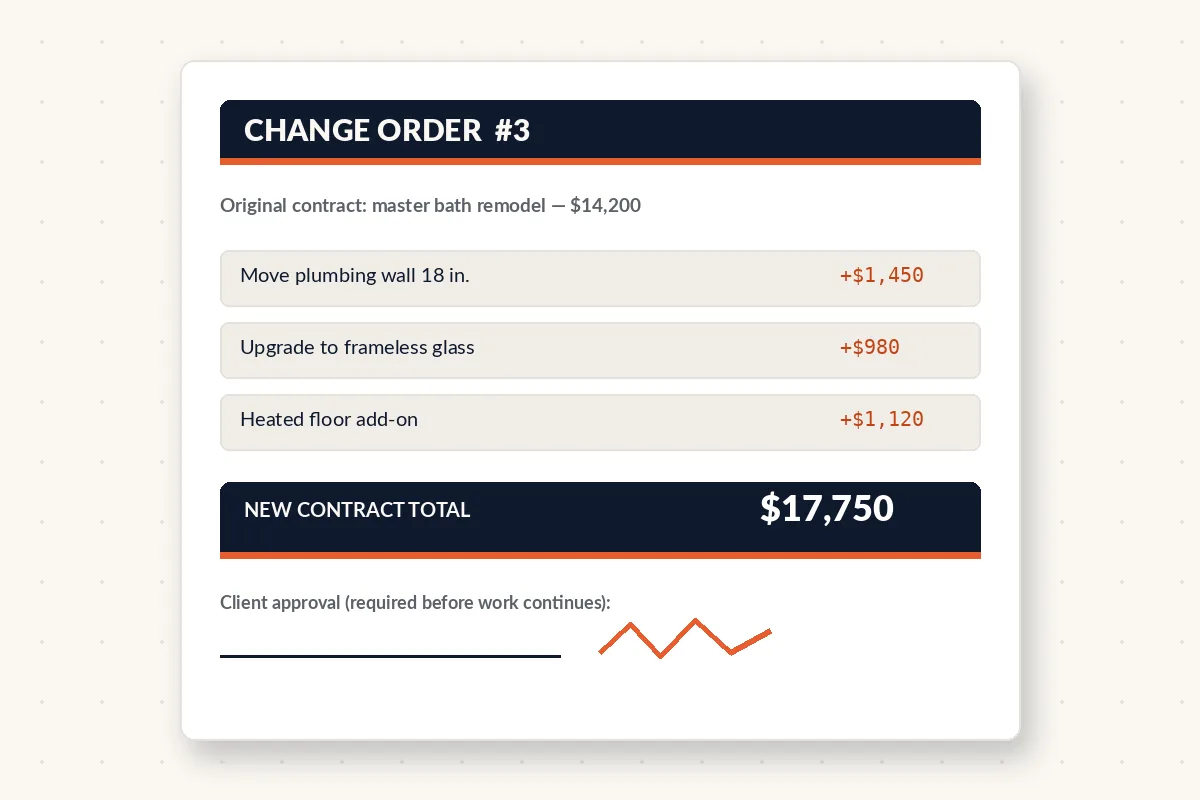
Why are change orders where the margin disappears?
On paper, a change order should be the most profitable work you do — the client is already committed, there’s no bidding competition, and mobilization is already paid for. In practice it’s usually the opposite, for three reasons:
- It gets priced on the spot. The client asks “how much to also move that outlet?” and you throw out a number in the hallway with no materials count and no labor math behind it.
- It gets priced naked. That hallway number usually covers materials and raw labor only — no overhead recovery, no markup, no supervision time, no re-sequencing cost.
- It doesn’t get documented. By the final invoice, the client remembers a smaller number, or doesn’t remember agreeing at all — and now you’re negotiating your own money at the worst possible moment.
The fix isn’t complicated. It’s a repeatable pricing formula plus a one-page form. Both take under ten minutes per change.
What should every change order include?
A change order is a mini-contract. Whether you use our free construction change order form or your own, it needs six things:
- Reference to the original contract — job name, date, original contract price.
- Description of the change — specific enough that a stranger could tell what’s added or removed. “Move plumbing wall 18 inches per attached sketch,” not “bathroom changes.”
- Price of the change — one number, clearly added to (or subtracted from) the contract total, with the new contract total stated.
- Schedule impact — even if it’s “no change.” Added days you don’t document become “the contractor ran late.”
- Payment terms for the change — due with next progress payment, or 50% at signing for big adds.
- Signatures and date — client and contractor, before the work starts.
How much should you actually charge?
Use the same buildup you’d use on any estimate, plus one line most contractors skip:
- Materials at your real delivered cost, including waste factor.
- Labor at your loaded rate — wage plus payroll taxes, comp, and non-billable time. If you’ve never calculated it, a $28/hr wage is commonly a $45–$55/hr real cost.
- Your standard markup — the same percentage that’s on the base contract. A change order is not the place to apologize with a discount.
- An administrative/disruption fee. This is the line that makes change orders sane. Every change costs you time that isn’t on a ladder: re-ordering materials, re-sequencing subs, updating the schedule, writing the change order itself. A flat $50–$100 on small residential jobs and $150–$250 on larger ones is normal, defensible, and — bonus — it quietly discourages the daily “one more little thing.”
Worked example: mid-bath remodel, client wants the plumbing wall moved 18 inches. Materials $520, eight hours of labor at a $50 loaded rate = $400, subtotal $920. At a 35% markup that’s $1,242, plus a $100 admin fee — $1,342, quoted as $1,350. The hallway answer would have been “eh, maybe six hundred” — and that gap, two or three times per job, is an entire month of profit by year end.
How do you tell the client without souring the job?
Set the rule at contract signing, before there’s any tension: point at the change-order clause in your contract and say the line every experienced contractor eventually learns:
“Any change from this scope — even small stuff — gets a one-page change order with the price before we do it. It protects you as much as me: you’ll never get a surprise on the final invoice.”
Framed that way, the change order becomes a consumer-protection feature instead of a gotcha. Then, when the ask comes mid-job: “Happy to do that — let me price it properly tonight and text you the change order. If the number works, sign it from your phone and we’ll fold it right into the schedule.” You look organized, not obstructive.
When should you eat the cost instead?
Sometimes the smart move is writing a $0 change order. Good candidates: a genuinely trivial ask (moving a towel bar), a make-good on something that’s arguably your miss, or a strategic favor for a client who’s a referral machine. The rule is that free work still gets documented — a change order marked “No charge — included as a courtesy.” That line does two jobs: the client sees the real value of what they got, and the next ask doesn’t assume everything is free.
What if the client won’t sign?
Then the work doesn’t happen — calmly and without drama. “No problem, we’ll leave it as contracted.” A client who refuses to sign but still expects the work has told you exactly how the final invoice conversation will go. The signed base contract is what protects you here: if you’re working on a handshake with no written scope at all, fix that first — it’s a bigger leak than any single change order.
Get the paperwork this article describes
Both are free, no signup: the one-page construction change order form and the contractor contract template with the change-order clause built in. Want the full paid pack with every form QA’d against real jobs? Browse the template shop →
Change order pricing FAQ
Do I really need a signed change order for small changes?
Yes — signed can mean a text reply that says “approved, $250” if the change is genuinely small. The medium matters less than the trail: a price, in writing, agreed before the work. One-page forms or a text thread both beat memory.
Should change orders have a higher markup than the base bid?
Keep the same markup percentage but always add the admin/disruption fee. Inflating the markup itself feels punitive if the client compares numbers; a visible flat fee for processing the change is easier to defend and does the same margin work.
What if the change reduces the scope?
Write a deductive change order — same form, negative number. Credit the client the materials and labor you’re not spending, but not your markup on work already performed, mobilized, or ordered. Document it just as carefully: scope reductions cause final-invoice fights as often as additions do.
Can I just bill time-and-materials for changes?
You can — T&M with a not-to-exceed cap is legitimate for genuinely unknowable work (opening a wall). But give the cap in writing and update the client when you hit 75% of it. An open-ended T&M change with no cap is how a $900 surprise becomes a review that starts with “beware.”
Leave a Reply